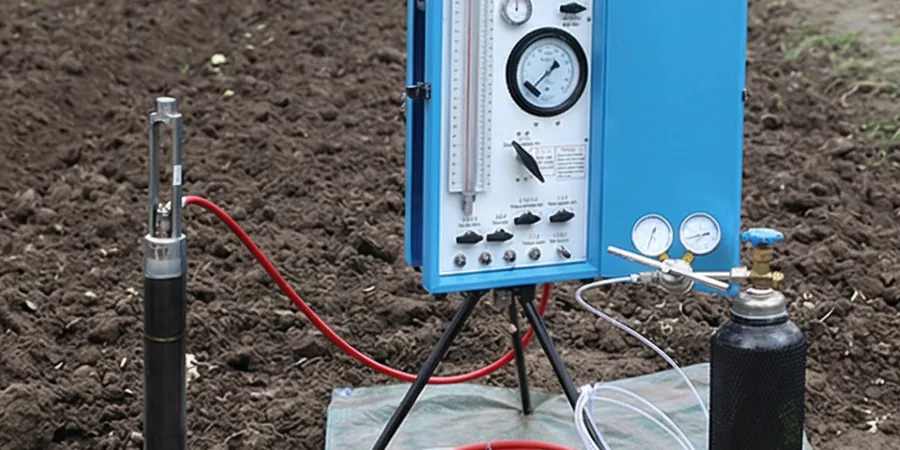
When designing foundations in Birmingham, the IBC and ASCE 7 reference the Ménard pressuremeter test (PMT) as a key method for measuring soil stiffness and limit pressure. For projects in the Valley Creek floodplain or on the weathered shale of Red Mountain, the PMT gives us a direct reading of the soil's stress-strain response. We pair this with a [MASW survey](/masw-vs30/) to map shear wave velocity across the site. The combination helps us calibrate settlement models for everything from retail pads to multi-story structures. Without PMT data, you are guessing at the modulus.
The PMT gives us the in-situ modulus directly — no empirical correlations needed. That matters when you design in Birmingham's variable residual soils.
Methodology and scope
We deploy a Menard-type probe with a 60 mm diameter and a 200 mm long measuring cell. The probe is hydraulically pushed or placed in a pre-drilled borehole. For Birmingham's mixed geology – clay over weathered limestone – we use a triple-wall sampler to avoid collapse. The test applies radial pressure in 1-minute load increments. We record the volume change in the measuring cell. This yields the pressuremeter modulus (E_M) and the limit pressure (p_L). We follow ASTM D4719-16 to the letter. The rig runs off a diesel power pack and fits standard 20-ton drill trucks. We also offer the PMT alongside plate load testing for shallow foundation verification on soft ground.
Technical reference image — Birmingham Alabama
Local considerations
Birmingham's development history tells a clear story. The city grew fast after the steel boom, often building on steep slopes and filled ravines. Many older structures in the Avondale and Five Points South districts sit on undocumented fill. That fill can settle or squeeze under load. The PMT catches this by measuring the soil's limit pressure directly. A low p_L means the soil will yield. We also correlate PMT data with SPT N-values to cross-check consistency. Ignoring the PMT in these conditions risks differential settlement that cracks slabs and walls.
How deep can the Ménard pressuremeter test reach in Birmingham?
We routinely test to depths of 30 meters. In the Cahaba Valley, we have reached 40 meters using a wireline system. The limit is the borehole stability in weathered rock.
How does PMT compare to the Standard Penetration Test (SPT)?
SPT gives a blow count index; PMT gives the actual soil modulus and limit pressure. For settlement calculations in Birmingham's clay, PMT is more reliable. We use both for cross-checking.
What is the typical cost for a PMT test in Birmingham?
The typical cost ranges from US$1,120 to US$1,100 per test point. The price varies with depth, access, and number of tests. Contact us for a site-specific quote.
Can you run PMT on a site with high groundwater?
Yes. We use a sealed probe and a grouted casing if needed. The test is not affected by water pressure as long as the borehole stays open. We have done this in Cahaba River alluvium.