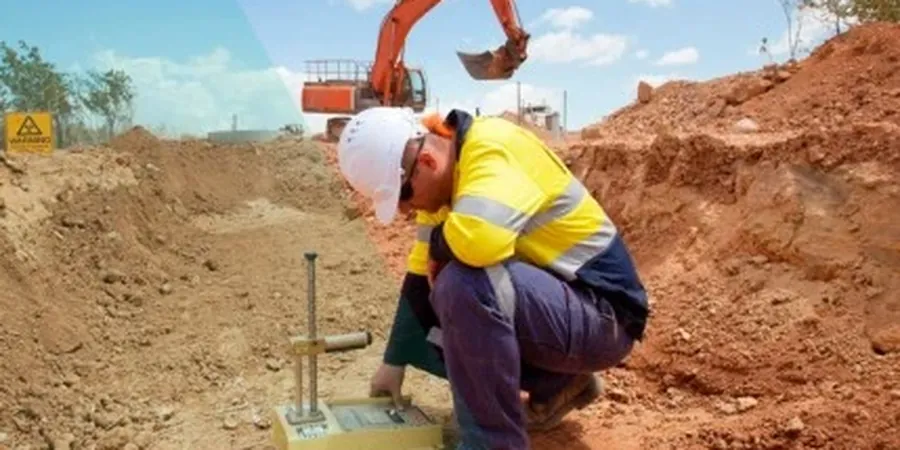
Birmingham Alabama sits on a mix of residual soils and weathered limestone. The clay content here is high, and it changes the way we approach subgrade design. We see pavements fail when the soil's plasticity is ignored. That's why our road geotechnics work starts with Atterberg limits and compaction curves. We tie every lab result to real traffic loads. Before you place asphalt or concrete, the subgrade must be stable. We often combine this with a California Bearing Ratio (CBR) test to get a direct measure of strength under soaked conditions. It's a local standard for a reason. The climate here — hot summers, wet springs — puts moisture right under the pavement. That's where good geotechnics pays off.
In Birmingham's clay-rich subgrades, soaked CBR values often drop below 3% without stabilization — that changes the entire pavement thickness design.
Methodology and scope
We see projects all over Jefferson County where the subgrade looks fine dry but turns to mush after rain. Our road geotechnics methodology accounts for that. We run Proctor compaction (ASTM D698) to find optimum moisture, then we test soaked CBR to simulate worst-case spring conditions. For high-traffic corridors like I-65 or I-459, we go deeper. A typical scope includes:
Boring logs every 500 ft along the alignment
SPT (ASTM D1586) for layer profiling
Resilient modulus estimation for AASHTOWare pavement design
We also check for swell potential using the free swell index test for expansive soils. If the soil swells more than 3%, we recommend lime stabilization or geogrid reinforcement. That's the kind of detail that keeps a road from cracking in two years.
Technical reference image — Birmingham Alabama
Local considerations
The biggest risk we see in Birmingham Alabama road projects is ignoring the clay layer beneath the topsoil. It's not always visible from the surface. A thin pavement over high-PI clay can fail in two seasons. We've seen edge cracking, rutting, and subgrade pumping within 18 months. The second risk is poor drainage — if water sits under the base course, the subgrade loses strength fast. That's why we always include infiltration testing and permeability checks. A road built without understanding the soil's wet behavior is a road that will cost more later.
We perform Standard and Modified Proctor compaction, soaked CBR, and Atterberg limits to classify subgrade soils. Results feed directly into AASHTO design charts.
Based on soil properties and traffic projections (ESALs), we recommend base thickness, subbase materials, and stabilization methods like lime or cement treatment for Birmingham Alabama conditions.
03
Drainage & Permeability Assessment
We evaluate subsurface drainage with falling-head permeability tests and infiltration rates. Proper drainage is critical for extending pavement life in Alabama's humid climate.
Applicable standards
ASTM D1883 (CBR for compacted specimens), AASHTO T-307 (Resilient modulus of soils), IBC 2021 Chapter 18 (foundations and subgrade preparation)
Frequently asked questions
Why is subgrade testing important before paving in Birmingham Alabama?
The local clay soils can lose strength when wet. Without testing, you risk premature cracking and rutting. We measure CBR, plasticity, and compaction to design a pavement that actually lasts.
What is the typical cost range for road geotechnics work in this area?
For a standard road project in Birmingham Alabama, expect between US$790 and US$4,530 depending on the number of borings, lab tests, and report depth. We can adjust scope to fit your budget.
How deep do you drill for pavement design?
We typically drill to 5–10 ft below the planned subgrade elevation. That captures the active clay zone and any weaker layers underneath. Deeper borings are added if embankments or cuts are involved.
Do you follow AASHTO or local Alabama DOT standards?
We follow AASHTO design methods (1993 or MEPDG) and incorporate ALDOT specifications for subgrade preparation. Our lab testing is done under ASTM standards to match both state and federal requirements.