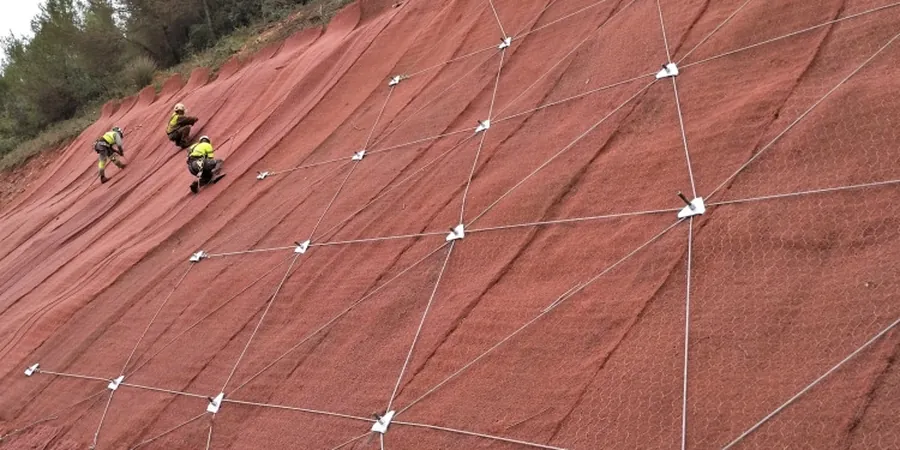
Birmingham Alabama sits on the Cumberland Plateau, where residual soils from weathered limestone and shale dominate the upper 15 to 25 feet. Below that lies a karstic bedrock profile with occasional solution cavities. These conditions demand a rigorous limit equilibrium approach for any slope excavation deeper than 10 feet. We model circular and non-circular failure surfaces using Bishop's simplified method and Spencer's method, both calibrated against local soil strength parameters obtained from consolidated-drained triaxial tests. Groundwater fluctuations during spring rains can reduce the factor of safety by 0.2 to 0.4, so we always include phreatic surface monitoring in our analysis.
A safety factor of 1.5 under static conditions can drop to 1.15 after 48 hours of sustained rainfall in Birmingham Alabama's residual clay profiles.
Methodology and scope
In Birmingham Alabama we see that many failed slopes occur not from poor material but from uncontrolled drainage. Surface runoff during a 50-year storm event can saturate the upper 6 feet of soil in under 2 hours. We integrate transient seepage modeling using SEEP/W coupled with SLOPE/W to capture pore-pressure buildup during heavy rainfall. Before running the stability model we always perform a falla-taludes back-analysis on any existing scarps in the area to estimate mobilized shear strength. For cuts in the Red Mountain Formation we also run corte-directo tests on bedding-plane samples since the anisotropy in that shale can reduce the factor of safety by up to 0.3 along weak layers.
Technical reference image — Birmingham Alabama
Local considerations
Birmingham Alabama grew rapidly during the post-war period, with many residential subdivisions carved directly into steep hillsides without geotechnical oversight. The result is a legacy of creeping landslides along the Shades Valley and Red Mountain escarpments. Several subdivisions built in the 1960s now show tension cracks in pavement and tilting retaining walls. We have documented cases where the original cut slope was designed at 1.5:1 (horizontal:vertical) with no subsurface drainage. After 30 years of seasonal wetting, those slopes have mobilized and now require tieback anchors or soil nail walls to stabilize. A proper stability analysis before construction could have avoided these multimillion-dollar repairs.
We run Bishop, Spencer, and Morgenstern-Price analyses on any slope geometry. For highways and large cuts we also perform 3D analysis using Slide3 to capture end-effects and lateral constraint. Results include critical slip surfaces, factor of safety contours, and sensitivity plots for cohesion, friction angle, and groundwater depth.
Birmingham Alabama is in Seismic Design Category C (ASCE 7-22). We compute pseudo-static safety factors using kh = 0.10–0.15 and evaluate permanent displacement via Newmark's sliding block method. For critical slopes near occupied structures we also run fully coupled dynamic finite element models in QUAKE/W.
Applicable standards
ASCE 7-22 (Minimum Design Loads for Buildings and Other Structures), IBC 2021 (International Building Code, Chapter 18), FHWA-NHI-05-088 (Mechanically Stabilized Earth Walls and Reinforced Slopes), ASTM D4767-11 (Consolidated-Undrained Triaxial Compression Test)
Frequently asked questions
What is the typical factor of safety required for slope stability in Birmingham Alabama?
The IBC 2021 requires a minimum factor of safety of 1.5 under static conditions for new slopes. For existing slopes or temporary excavations, 1.3 is often acceptable. In seismic cases we use 1.1 or perform a Newmark displacement check.
How much does a slope stability analysis cost in Birmingham Alabama?
A standard 2D limit equilibrium study with one groundwater scenario typically ranges between US$1.260 and US$3.880, depending on slope complexity, number of soil layers, and whether laboratory testing is included. Seismic analysis adds 20–30%.
What soil tests are needed for a reliable stability model?
We require at minimum consolidated-drained triaxial (ASTM D7181) or consolidated-undrained triaxial with pore pressure measurement (ASTM D4767) for each distinct soil layer. For residual clays in Birmingham Alabama we also run Atterberg limits (ASTM D4318) to verify plasticity and shrinkage potential.
Can you analyze a slope that already has cracks or movement?
Yes. We perform a back-analysis on the existing failure surface to determine the mobilized shear strength at the moment of movement. That value becomes the lower-bound strength for redesign. We also recommend installing inclinometers and piezometers to monitor ongoing movement and pore pressure trends.