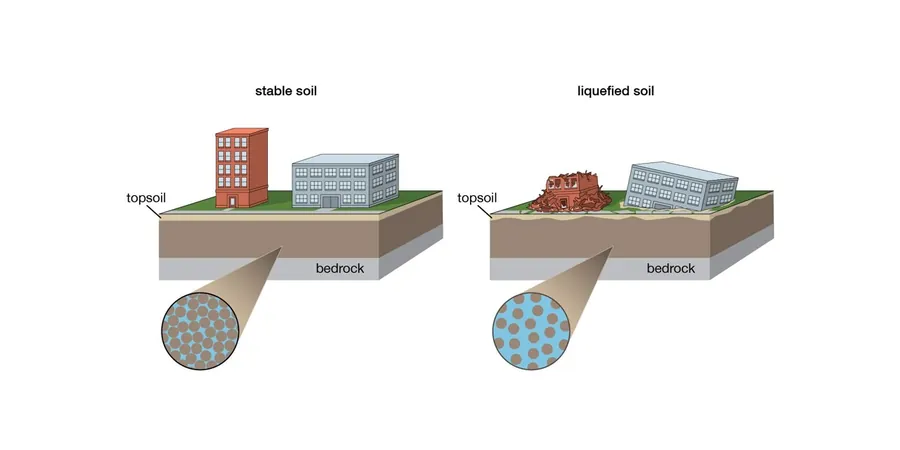
Birmingham Alabama grew fast during the industrial boom of the late 1800s, with mills and rail lines spreading across the Jones Valley. That rapid development meant many structures went up before modern geotechnical standards existed, and the underlying geology — a mix of residual soils over Paleozoic limestone and sandstone — creates real challenges for seismic design. When we evaluate soil liquefaction analysis in Birmingham Alabama, we start by looking at the groundwater levels near Village Creek and the Cahaba River, because shallow water tables in those alluvial zones can amplify risk during a seismic event. Combining that local knowledge with NCEER-based SPT methods gives us a clear picture of where cyclic softening is likely, and we often pair this work with a MASW survey to measure shear wave velocity profiles across the site.
For sites in Birmingham Alabama, shallow groundwater in alluvial zones near Village Creek can turn a moderate seismic event into a serious foundation risk if liquefaction is not evaluated early.
Methodology and scope
A common mistake we see from contractors here is assuming that all of Birmingham Alabama sits on competent rock, when in fact large portions of the eastern suburbs like Irondale and the areas around Red Mountain have deep colluvial deposits that behave poorly under cyclic loading. The soil liquefaction analysis we run follows the Youd-Idriss 2001 protocol, using corrected N-values from SPT borings to compute factor of safety against liquefaction. We also check fines content per ASTM D2487, because silty sands common in the Cahaba basin can shift behavior drastically. For sites near the old slag fill zones west of downtown, we recommend a preloading program to densify loose granular layers before foundation work begins. And when the analysis shows marginal safety factors, we cross-reference with the CPT soundings to get continuous profiles that capture thin liquefiable seams.
Technical reference image — Birmingham Alabama
Local considerations
In Birmingham Alabama, a lot of the older industrial sites along the railroad corridors have undocumented fill layers — cinders, foundry sand, demolition debris — that nobody tested before building on them. If those materials are loose and saturated, they can liquefy under a ground acceleration as low as 0.15g, which is within the design earthquake for this region per USGS hazard maps. We have seen cases where a routine warehouse slab cracked and heaved years later because nobody ran a proper soil liquefaction analysis before pouring concrete. The real danger is differential settlement: one corner of the building drops six inches while the other stays put, and suddenly the steel frame is racked.
SPT-based CRR/CSR calculation per Youd-Idriss 2001 with fines correction, delivering factor-of-safety profiles at each boring location for multiple earthquake magnitudes.
02
Post-Liquefaction Settlement Estimate
Volumetric strain and reconsolidation settlement computed using Tokimatsu & Seed or Ishihara & Yoshimine methods, with depth-integrated LPI values for site zoning.
03
Lateral Spread & Flow Slide Assessment
Evaluation of permanent lateral displacement using Newmark sliding block analysis and empirical models from Bartlett & Youd for slopes and free-face conditions.
Applicable standards
ASCE 7-22 (Seismic Load Requirements & Site Class F), NCEER 1997 / Youd-Idriss 2001 (SPT-Based Liquefaction), ASTM D1586-18 (Standard Test Method for SPT), FHWA NHI-05-032 (Liquefaction Evaluation Guidelines)
Frequently asked questions
What is the difference between liquefaction triggering and post-liquefaction settlement?
Triggering analysis tells you if the soil will lose strength during shaking, using the CRR versus CSR comparison. Post-liquefaction settlement estimates how much the ground will compact vertically after the pore pressures dissipate. Both are needed for a complete soil liquefaction analysis in Birmingham Alabama because a site that triggers may still settle only a few centimeters, while another with a high factor of safety could have deeper loose layers that consolidate over weeks.
How much does a soil liquefaction analysis cost in Birmingham Alabama?
The typical range for a commercial site evaluation runs between US$2.670 and US$3.730, depending on the number of borings, required laboratory testing for fines content, and whether you need VS30 measurement for site class confirmation. Larger projects with multiple boring locations or deep groundwater monitoring will fall at the higher end.
Which soil types in the Birmingham area are most susceptible to liquefaction?
Loose, saturated, uniformly graded sands and silty sands with fines content below 15% are the highest risk, especially in Holocene alluvial deposits along the Cahaba River and Village Creek floodplains. The residual soils overlying the Red Mountain Formation sandstone tend to be clay-rich and less prone to triggering, though colluvial sand layers in the eastern suburbs can still reach critical density states.
Do I need a liquefaction analysis for a small residential addition?
For a single-story slab-on-grade addition on a site with documented stiff clay or weathered rock, the risk is low enough that a simplified screening per IBC Section 1803.5.12 may suffice. But if the addition sits within 100 feet of a mapped stream or in an area with known shallow groundwater (less than 10 feet deep), we recommend at least a preliminary soil liquefaction analysis to avoid differential settlement that could crack the new foundation.