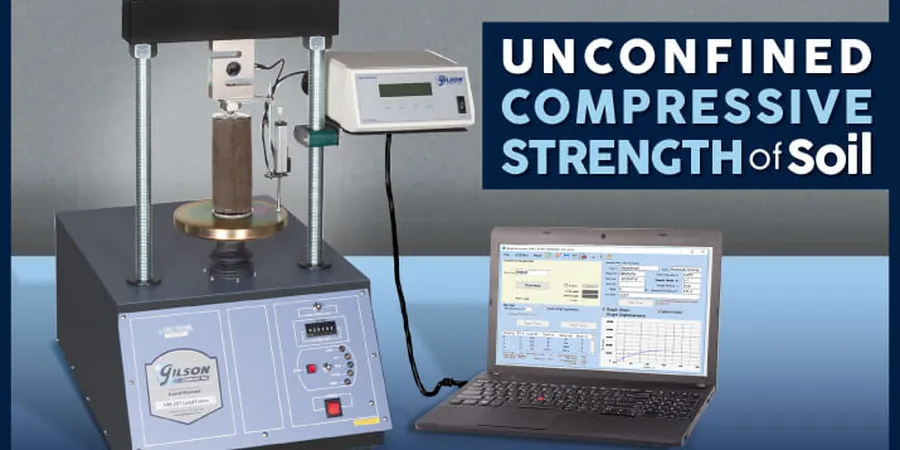
A parking garage on 2nd Avenue North hit soft clay at 4 meters depth. The structural engineer needed undrained shear strength values fast. That is exactly when the unconfined compression test (UCS) becomes the go-to lab procedure. We ran twelve UCS specimens from that site in one afternoon. The test uses a cylindrical soil sample loaded axially with no confining pressure. It gives a direct read of qu (unconfined compressive strength). For preliminary design in Birmingham Alabama, the UCS test is often the first strength parameter the geotechnical report shows. Before deeper investigation like a plate load test or a CPT sounding, the UCS provides a quick baseline for cohesive materials. We trim the sample, measure moisture content, and load it at a constant strain rate until failure. The whole cycle takes under 15 minutes per specimen.
Unconfined compression test delivers undrained shear strength from a single undisturbed sample in 10–15 minutes, critical for preliminary design of shallow foundations in cohesive soils.
Methodology and scope
Birmingham Alabama sits on the Cahaba Valley with residual clays and weathered shale. These soils are highly cohesive but sensitive to disturbance. The unconfined compression test is ideal here because it preserves natural structure. We follow ASTM D2166-16 strictly. The specimen diameter is 38 mm minimum and height is roughly twice the diameter. We check the strain rate at 0.5 to 2.0 percent per minute depending on plasticity. For low-plasticity clays common in the eastern part of Birmingham Alabama, we use 1.0 percent per minute. The test generates stress-strain data that yields qu and the failure strain. We also calculate the undrained shear strength su = qu/2. This parameter feeds directly into bearing capacity equations per IBC 2018. When the sample contains fissures or slickensides, the UCS value drops. That is why we correlate UCS results with Atterberg limits to confirm soil classification and remolding sensitivity.
Technical reference image — Birmingham Alabama
Local considerations
Birmingham Alabama averages 52 inches of rainfall per year. High moisture cycles cause clay shrinkage and swelling. The unconfined compression test on a saturated sample may show qu values 30 to 50 percent lower than the same soil at natural moisture. That can mislead foundation design if the lab does not condition the sample correctly. Another risk is sample disturbance. Drilling in the Ridge-and-Valley geology around Birmingham Alabama often produces blocky or fractured Shelby tube samples. A disturbed sample tested with UCS yields artificially low strength. We reject any specimen with visible cracks or voids before trimming. The test cannot account for anisotropic stress states either. That limitation is critical when designing cuts or slopes in the Cahaba shale. For those cases we combine UCS data with direct shear or triaxial tests.
qu (unconfined compressive strength), su (undrained shear strength), failure strain
Applicable soils
Cohesive soils (clay, silt-clay, clayey shale)
Associated technical services
01
Unconfined Compression on Undisturbed Samples
We test Shelby tube and block samples from boreholes across Birmingham Alabama. The procedure includes moisture content determination, unit weight measurement, and stress-strain curve plotting. Results include qu, su, and failure strain. Our report provides the IBC 2018 bearing capacity calculation derived from UCS data. Typical turnaround is 48 hours.
02
UCS on Remolded and Reconstituted Specimens
For earthwork quality control or slope stability analysis, we remold samples to target density and moisture. We then run UCS to measure strength loss after disturbance. This is common for fill materials used in highway embankments around Birmingham Alabama. The test helps verify compaction effectiveness and long-term stability.
What is the difference between unconfined compression test and uniaxial compression test?
They are the same test. Unconfined compression test (UCS) and uniaxial compression test both refer to loading a cylindrical soil sample axially with zero confining pressure. The term UCS is more common in geotechnical practice. ASTM D2166 uses unconfined compression test.
How much does an unconfined compression test cost in Birmingham Alabama?
The typical range for a single UCS test in Birmingham Alabama is US$310 – US$550 per specimen. The price depends on sample condition, number of specimens, and whether moisture content and unit weight are included. Volume discounts apply for projects with more than 10 specimens.
Can UCS be used for all soil types?
No. UCS is only valid for cohesive soils – clays, silty clays, and clayey shales. Granular soils like sands and gravels cannot be tested because they lack cohesion. For sands we recommend direct shear or triaxial tests with confining pressure. The test also fails on fissured or highly fractured clay where the failure plane is pre-existing.
How long does it take to get results from a UCS test?
A single specimen takes about 10 to 15 minutes to test in the loading frame. Sample preparation including trimming, moisture measurement, and dimension recording adds 20 minutes. For a batch of 6 specimens, we deliver the complete report within 48 hours. Rush service is available for same-day turnaround on small batches.
What is the typical qu value for clays in Birmingham Alabama?
Residual clays from the Cahaba Formation in Birmingham Alabama typically show qu values between 50 and 120 kPa. Soft alluvial clays along Valley Creek can be as low as 25 kPa. Weathered shale zones may reach 200 kPa. These values vary significantly with moisture content and depth, so multiple UCS tests across the site are recommended.